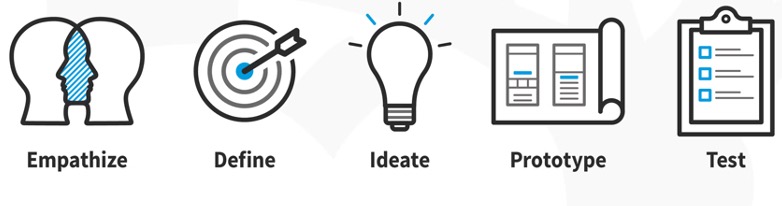
You may be asking yourself: What exactly is design thinking? While the concept of “design thinking” is relatively new, the elements that make it up are not. In fact, design thinking has been around long before it was called design thinking.
When I first heard the term design thinking, I wasn’t sure what to think. There were a lot of thoughts of what it could possibly mean, with a lot of overlap, but I couldn’t zero in on a certain one. I figured it had to do with design (obviously) and maybe the process of going about designing something (getting closer). But what never occurred to me was that empathy would be the first step. Because what do feelings have to do with designing with something? More than most of us think apparently.
The Scientific Method?

When I first saw the layout of design thinking I couldn’t help but make a comparison to the scientific method. We all learned about it in school before doing science fair. Ask a question, make a hypothesis, create an experiement, analyze the results, draw a conclusion. Do you see the similarities? What I found interesting from this comparison was that even though the processes resemble one another (more or less), there really isn’t that much overlap between the two ideas.
I actually went through the process of design thinking (See Doing the Design Sprint) and found it to be different than the countless times of doing the scientific method. The major difference I noticed was that there was a lot more human interaction, which goes back to that first step being empathize. The rest of the steps align with each other pretty well. But I think that first step is crucial to differentiating between design thinking and the scientific method. It is what I believe is and has been missing from our society for a long time. Empathy.
The Steps of Design Thinking

While the 5 main steps of the design thinking process are: empathize, define, ideate, prototype and test, I like this graphic because it includes one additional step: implement. If something may have had a good outcome in a “test” group, what’s to say it’s going to have that same outcome once it is introduced more widely. It might perform the same. But there is a chance that it could perform worse. New problems could arise that hadn’t been a problem in the test stage.
What I also like about this graphic is that it includes arrows leading back to previous steps. It is a visual representation that even though this process might appear to be a linear one, you can always go back and try something again if it didn’t work out for you. The prototype step even has two arrows. One going back to design and the other going all the way back to empathize. Myabe just that prototype idea didn’t work out. Or maybe the whole concept that was created through ideate and design needs to be redone. There is room for error.
 From Nockmaar to Tir Asleen
Leave a comment