Whether we realize it or not, every single decision we make, especially online, is formulated from many possible previous decisions. Some of these past decisions could be dictated by the very people who designed what is being viewed. Designers have come to use this for their (or their company’s) own gain. Not only can they manufacture what we choose but also how picking each thing will make us feel. They do this by applying behavioral economics to standard design principles.
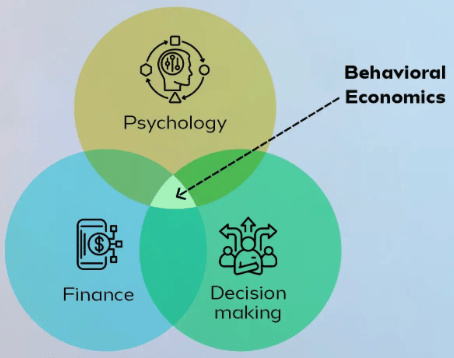
As the picture above shows, behavioral economics is the overlap between psychology, decision making and finance. Collectively, these three concepts work together to create their own overlap between human behavior and economics.
A vital piece of incorporating behavioral economics into the world of design is what is called a ‘nudge’. Nudges are intentional features added that subconsciously make our minds recognize them as something we want. To get more clicks or views on a certain page, there are ways to make buttons more attractive and pleasing than others might be.
There is also a whole book worth of research associating specific colors and different styles with various emotions. While these color attractions may not work for everyone who might come across the design, it does work for the vast majority.
Behavioral economics has some ethical concerns surrounding it. Since it is a way to intentionally ‘persuade’ people, it needs to be added in moderation and for the right reasons. What is considered right is open to interpretation due to the fact that ultimately the most popular reason would be to attract more customers, in return more money for a company. Ultimately, if it isn’t causing people to have negative ramifications then it should be considered alright to use.
With technology evolving ever so rapidly, there will soon be more that can come of behavioral economics and the effects of it. Artificial intelligence will most likely soon be able to predict how or what an individual might click and tailor pages specifically to them. Another aspect that can quickly change is having real-time feedback for the designers and the companies to see how their ‘nudges’ are working. Instead of waiting for the typical daily report, there can be information instantaneously about what demographic of people were more apt to click and view.
It’s rise and so-far proven success is allowing for behavioral economics to become an integral part of the design curriculum. However, the more it is exposed, the more possible it is for people to become aware of what is intentionally happening to them. Many are probably abstractly aware that it is happening, but not as it being a defined method. This could potentially lead to even more distrust with technology. Some might just not really care.
 From Nockmaar to Tir Asleen
Leave a comment